
Few outcomes confuse business leaders more than this: a company hires a dedicated HR team, implements structured interview guides, standardizes review cycles, and documents policies, yet critical people decisions continue to backfire.
Misaligned senior hires stall out within months. Exceptional individual contributors are promoted into managerial roles where they struggle. Toxic top producers are protected until cultural morale fractures. Meanwhile, your best talent quietly departs for competitors.
When competent HR teams facilitate poor people outcomes, it is rarely due to negligence or a lack of effort. It happens because organizations frequently expect administrative process to replace executive judgment.
Quick Answer
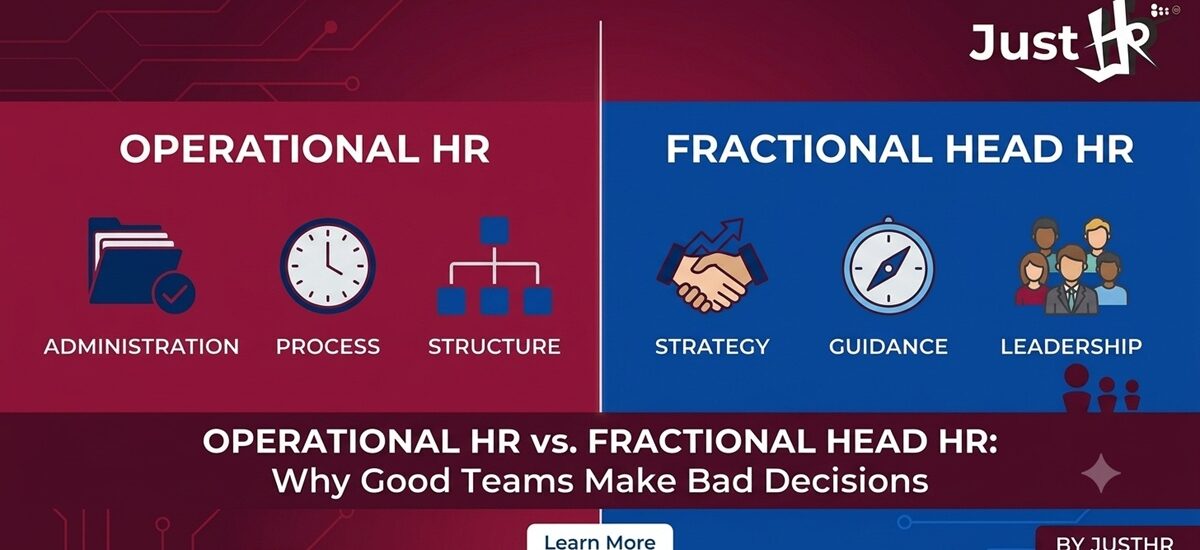
Good HR teams make poor people decisions when policy and process execution are applied without deep business context and accumulated judgment. While HR rules, compliance, and recruitment workflows can be learned quickly, judgment the ability to evaluate organizational trade-offs, team dynamics, and leadership capability is accumulated over years of business exposure. Layering a Fractional Head HR above an existing HR engine introduces high-level judgment without requiring a full-time executive hire.
| Dimension | Operational HR Focus | Strategic Senior HR Focus |
| Primary Driver | Rules, Checklists & Workflows | Business Context & Outcomes |
| Risk Perspective | Compliance & Legal Exposure | Organizational & Strategic Risk |
| Execution Style | Process Adherence | Contextual Trade-off Analysis |
| Talent Strategy | Role Fulfillment & Headcount | Long-Term Capability & Fit |
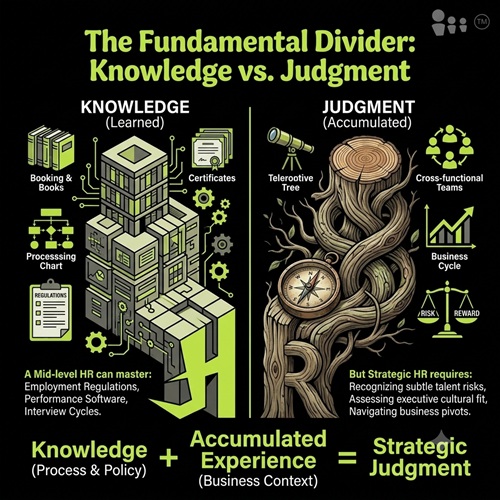
The Fundamental Divider: Knowledge vs. Judgment
Understanding why well-intentioned HR processes fail begins with a core reality:
“Knowledge can be learned. Judgment is accumulated.”
A mid-level HR professional can easily master employment regulations, run structured interview cycles, and manage performance software. That represents knowledge.
However, recognizing that a star sales director’s behavior is quietly driving away three critical account managers, or determining whether an executive candidate can thrive under rapid operational pivots, requires judgment.
Judgment requires years of navigating business cycles, analyzing cross-functional trade-offs, and witnessing the long-term impact of talent decisions. Expecting operational staff to exercise C-suite judgment without senior guidance is an unfair ask. Different levels of HR experience exist to solve different levels of organizational complexity.
Knowledge (Process & Policy) + Accumulated Experience (Business Context) = Strategic Judgment
5 High-Stakes Decisions Where Process Alone Fails
1. The Executive Hire: Resume Matches vs. Contextual Fit
Operational HR screens for keywords, degrees, and brand-name company backgrounds. Senior HR judgment looks deeper: How does this leader operate under stress? Do they build trust or rely on authority? Will their management style mesh with the founder’s vision?
2. The Toxic High-Performer Dilemma
Operational frameworks default to quantifiable metrics revenue closed, software shipped, or targets achieved. Strategic HR judgment evaluates the broader net impact, recognizing when an individual’s short-term output creates long-term organizational damage.
3. The Promotion Trap: Top Contributor to Struggling Manager
Promoting top individual performers is a standard operational reward. Strategic HR evaluates future managerial capability, emotional intelligence, and team leadership potential—preventing the common mistake of losing a great specialist to gain an ineffective manager.
4. Rigid Policy Application vs. Retention
When personnel issues surface, operational HR defaults strictly to the employee handbook. While consistency is vital, rigid policy enforcement without business context creates bureaucratic friction that alienates key talent. Senior HR leaders know when to apply rules firmly and when to adapt frameworks to protect business goals.
5. Escalation Bottlenecks
When an internal HR team lacks strategic authority or judgment, non-standard people challenges inevitably get pushed up to the founder or CEO. HR becomes a transactional pass-through rather than an effective decision-making filter.
Elevating HR Capability Respectfully
Addressing this gap does not mean dismantling your internal HR department or faulting mid-level teams. Operational HR professionals are essential for keeping pipelines moving, ensuring compliance, and handling daily workplace administration.
What growing organizations need is seasoned business judgment layered over their existing operational foundation.
Unlocking executive-level judgment does not always require adding a costly, full-time C-suite salary to your payroll. An embedded Fractional Head HR can provide the necessary executive oversight, audit key talent decisions, coach internal managers, and mentor your existing HR staff elevating decision quality across the entire organization.
The JustHR Approach: Strategic Leadership Partnering
At JustHR, we view HR as a strategic growth engine rather than a purely administrative function. We do not simply supply HR headcount to manage routine tasks; we partner with founders and executive teams to provide senior HR leadership and high-level decision support.
Whether you need to resolve structural leadership bottlenecks, refine succession strategies, or integrate executive oversight alongside your current HR team, our Fractional Head HR framework provides clarity when critical people decisions are on the line. Explore our case studies to see how strategic HR judgment transforms organizational outcomes.
FAQ Section
- Why do experienced HR teams still make hiring mistakes? Mistakes often happen when candidate evaluation relies strictly on resumes and rigid skill checklists, rather than assessing cultural alignment, adaptability, and broader business context.
- How does operational HR differ from strategic HR leadership? Operational HR focuses on process execution, compliance, leave tracking, and transactional hiring. Strategic HR evaluates organizational risk, leadership potential, team dynamics, and business trade-offs.
- Can a company add senior HR judgment without hiring a full-time CHRO? Yes. Bringing in a Fractional Head of HR allows businesses to access executive guidance and decision-making frameworks on a flexible basis while keeping their existing operational HR team intact.