Table of Contents
Introduction
Do you know that over 75% of resumes are rejected by Applicant Tracking Systems (ATS) before they ever reach a recruiter? This means that even highly skilled professionals often get filtered out without a chance to showcase their talent.
The silence after sending job applications can be discouraging. If you’re struggling to get interview calls, you’re far from alone. So many skilled professionals face long stretches without even a reply. Sometimes, the reasons behind things aren’t immediately clear, but with a few focused adjustments, you can really start to see some positive changes. This article dives into the specifics of why certain applications might be overlooked, shares effective strategies to turn things around, and offers insights from experts as well as individuals who have successfully navigated this common hurdle.
“A resume today is less about listing experience and more about marketing your value. Candidates who tailor their resume to the ATS see up to 3x higher interview rates.” — Rakesh Malhotra, Career Coach
Why Many Job Seekers Struggle to Get Interview Calls
If you keep getting ghosted, it’s not just you. Most job seekers hit this wall. Here are the most common reasons why interview calls don’t come your way:
- Applicant Tracking Systems (ATS) Filtering Resumes: Most companies use software to scan and rank resumes. If your resume lacks specific keywords from the job ad, it may never reach human eyes. This is one of the major reasons why you are Struggling to Get Interview Calls.
According to Careerminds, “More than 75% of resumes parsed by ATS are never seen by a human” due to formatting or keyword mismatches and 88% of employers say they lose out on high-quality candidates filtered out by ATS simply for not being ATS-friendly
- Generic Applications: Sending out the same resume and cover letter to every job wastes time. Companies want to see you’ve paid attention to their posting.
- Missing Keywords: Resumes that don’t echo the language used in the job description are often filtered out by ATS or hiring managers.
- Weak Online Profiles: Employers search candidates online. A bare-bones LinkedIn profile without clear accomplishments hurts your chances.
As Per Experts, Resumes with a LinkedIn profile link have a 71% higher interview rate (13.5% callback vs. 7.9%). Source - Lack of Networking: Many jobs get filled internally or through referrals before ads even go live. It is another reason why you are Struggling to Get Interview Calls
For a deeper dive into frequently overlooked reasons, see the detailed analysis in Nine Reasons Your Job Application is Being Ignored.
Proven Strategies to Boost Your Chances of Getting Interview Calls
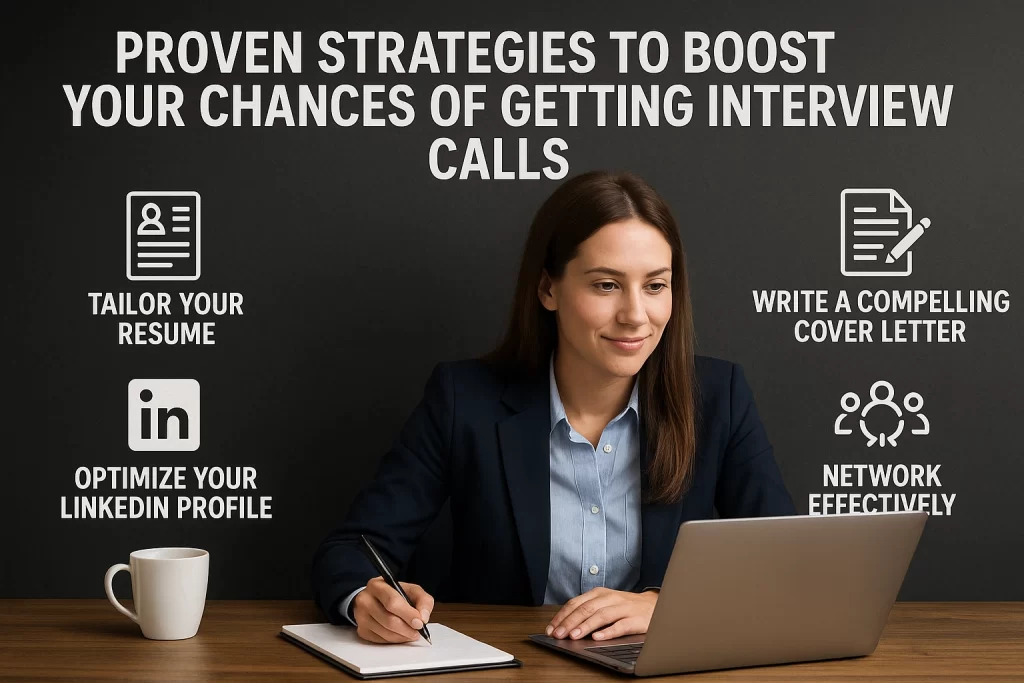
Tailor Every Resume and Cover Letter
Generic applications just blend in with the crowd. Ensure that you customize your resume and cover letter for each job you apply to. Use the same keywords and phrases that you find in the job description to really catch their attention. Use numbers to show what you accomplished before, like “boosted sales by 18% in one year” or “managed a team of six.” Small details make you relevant to each employer.
Tips:
- Match your job titles and skills to the wording in the job posting.
- List results and achievements, not just duties.
- Write concise cover letters that address the specific company’s needs.
Strengthen Your Online Presence
Your LinkedIn profile is often the first “interview.” Hiring managers look beyond your resume to see if you’re credible and current. An empty or outdated page is a red flag. Instead, fill out every section with specific results and skills. Add examples of your work if possible and use targeted industry keywords.
For a full checklist, check out 12 steps to a better LinkedIn profile in 2025.
Make your profile pop:
- Use a professional headshot.
- Update your headline with key skills.
- Write a strong summary that’s clear and direct.
- Engage in groups and share relevant content.
Leverage Networking to Find Hidden Opportunities
Applying online isn’t enough. A personal connection inside the company can get your resume in front of a real person. Referrals carry weight. Talk to current employees, reach out to former coworkers, and even chat with industry contacts you haven’t spoken to in a while. Email or message them don’t just rely on social media likes.
Simple networking steps:
- Attend industry events, online or in person.
- Join professional groups and actively participate in discussions.
- Ask for informational interviews to learn about the company culture.
- Look for alumni from your college who work at your target companies.
Follow Up After Each Application
Don’t just wait and hope. Track every application in a simple spreadsheet or using job search tools. One week after applying, send a polite email to the hiring manager to show your interest. Short, friendly follow-ups can push your application to the top of the pile.
Polite follow-up template example:
Hi [Name],
I recently applied for the [Job Title] position. I’m excited about the opportunity and wanted to confirm my application was received. Please let me know if you need any other information. Thanks for your consideration.
Proactive communication can break you out of the silent waiting game.
📊 Table: Comparison of Common Reasons Why Candidates Don’t Get Interview Calls
| Factor | Impact on Job Search | Example | Fix/Strategy |
| ATS Filtering | 75%+ of resumes are rejected before reaching HR | Resume missing keywords like “SEO” or “Project Management” | Use ATS-optimized resume with targeted keywords |
| Generic Applications | Applications feel irrelevant to recruiters | Sending same CV to IT & Marketing roles | Tailor resume + cover letter for each role |
| Weak LinkedIn Profile | Recruiters skip candidates without online credibility | Empty LinkedIn with no achievements listed | Update headline, add metrics, join groups |
| Lack of Networking | 60–70% of jobs are filled through referrals (LinkedIn data) | Applying only via job portals | Build connections, request referrals |
| No Follow-Up | Application gets buried under new ones | No communication after applying | Send a polite follow-up after 1 week |
✅ Myths vs Facts: Job Applications & Interview Calls
| Myth | Fact |
| “If I send my resume to 100 jobs, I’ll surely get an interview.” | Quality > Quantity. Tailored resumes get 3x more interviews (TopResume, 2023). |
| “ATS only rejects fancy resumes, not simple ones.” | ATS rejects resumes missing keywords/formatting, not design alone (Jobscan, 2024). |
| “LinkedIn is optional; only resumes matter.” | 87% of recruiters check LinkedIn before shortlisting (Jobvite Recruiting Benchmark, 2023). |
| “Networking only works for senior-level jobs.” | Referrals help at all levels; 60–70% of jobs are filled through networking. |
| “Following up annoys recruiters.” | Polite follow-ups show interest and can push your resume to the top. |
📋 Checklist: 7 Things to Check Before Sending Your Resume
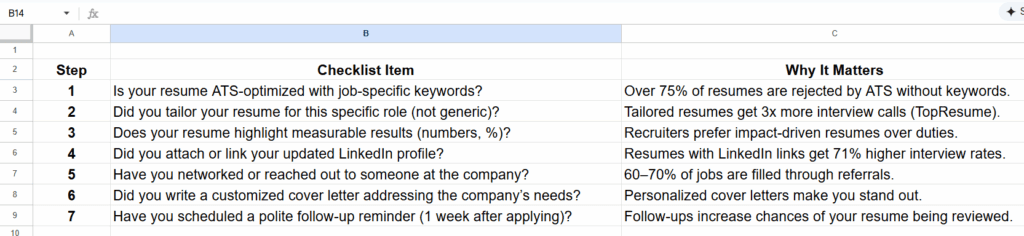
Get A Copy Of the Checklist Here.
Expert Insights and Real-Life Case Studies
Hiring managers really emphasize the need to customize your applications. A lot of them point out that many resumes tend to look the same and don’t highlight results effectively. Career coaches suggest that you should tailor not just your documents, but also your overall approach.
Real-life example:
Amrita, a digital marketing specialist, sent out nearly 100 one-size-fits-all resumes and got zero interviews. She researched how to use keywords and tailored each application. Within weeks, she was getting responses and landed two interviews in a month.
Career pros at JustHr offer tailored resume reviews and LinkedIn makeovers that have directly helped clients raise their interview call rates. These experts echo a simple truth: most employers skip applicants who don’t show careful preparation. Plus JustHr also have 20+ years of experience in this industry. Plus JustHr one of the best Resume writing companies in Delhi.
Testimonials for JustHr
1. Career Switch Success
“I had been applying for jobs for 6 months with no response. After JustHr rewrote my resume with ATS optimization, I started receiving interview calls within 2 weeks. Their LinkedIn makeover also boosted my visibility. I finally landed a digital marketing role at an MNC.”
— Rohit Sharma, Digital Marketing Specialist, Delhi
2. Executive-Level Resume Transformation
“As a senior finance professional, I needed a resume that reflected my leadership and achievements. JustHr’s team built a powerful, executive-level resume that impressed recruiters. Within a month, I secured 3 interviews and an offer with a Fortune 500 company.”
— Anita Mehra, Senior Finance Manager, Gurgaon
Frequently Asked Questions About Struggling to Get Interview Calls
Why don’t I get responses after sending dozens of applications?
Most applications are screened by ATS first. Missing keywords or sending the same resume to many jobs lowers your chances. Research each job and match your resume closely.
What if my experience isn’t a perfect match?
Highlight transferable skills. Employers value adaptability. Focus on what you brought to previous roles that fits the new job.
How long should I wait before following up?
One week is enough. A friendly, concise email after a week shows you care.
What can I do if I’m completely ignored?
Revisit your resume and online profile. Try connecting with current employees. If possible, work with professionals like JustHr who can review your materials and style for weak spots.
1. Why am I not getting interview calls even with experience?
Most resumes are filtered by Applicant Tracking Systems (ATS). Over 75% of resumes never reach a human recruiter if they don’t match keywords from the job posting (Careerminds, Jobscan).
👉 Fix: Use job-specific keywords and keep formatting ATS-friendly.
2. Does LinkedIn really matter for interview shortlisting?
Yes. 87% of recruiters check LinkedIn profiles before calling candidates (Jobvite, LinkedIn Talent Blog).
👉 Fix: Add a professional headline, summary, and measurable results to boost visibility.
3. Is sending more resumes better than tailoring each one?
No. Research shows tailored resumes get 3x more interview calls than generic ones (TopResume).
👉 Fix: Customize your resume & cover letter for each job description.
4. How important is networking for getting interview calls?
Extremely important. 60–70% of jobs are filled through referrals and networking (LinkedIn Workforce Report).
👉 Fix: Build connections, ask for referrals, and engage with alumni/professional groups.
5. Should I follow up after applying for jobs?
Yes. A polite follow-up email 1 week after applying increases chances of your resume being reviewed (Glassdoor).
👉 Fix: Keep it short, professional, and show genuine interest.
Conclusion
Struggling to get interview calls frustrates even the most qualified candidates. Often the fix is not sending more applications but changing your approach: tailor every resume, strengthen your online presence, build connections, and follow up smartly. Persistence and small adjustments matter. Many have turned things around by following these strategies. If you want expert, hands-on support to sharpen your job search, look to JustHr for practical help. Take control of your career story so the calls finally start coming in.
This article was carefully designed to address one of the biggest frustrations job seekers face and to show that the problem is not a lack of talent, but the wrong strategy. By blending expert opinions, real-life case studies, data-backed insights, and practical checklists.
Every point here is crafted to make job seekers feel truly understood while providing a clear path to boost their chances of landing interviews. That’s why, instead of offering generic advice, this content dives into proven strategies and expert insights—so you don’t just read, but you take action and ultimately see real results.
For More Information & Help Visit Us.