

Table of Contents
Summary
Scaling a startup isn’t just about great products or funding — it’s about building the right team systems early. According to CB Insights, nearly 60% of startup failures happen due to people and HR-related issues, not market or product flaws. That’s where a fractional or virtual CHRO service becomes a game-changer.
A CHRO (Chief Human Resources Officer) service gives startups access to senior HR expertise on a flexible basis — without the full-time cost. Instead of hiring a costly executive, startups can bring in a fractional CHRO who sets up scalable systems for hiring, onboarding, pay benchmarking, and compliance. This lets founders focus on growth while ensuring HR operations are smooth, legal, and aligned with business goals.
As startups grow beyond 10–12 employees, manual HR processes and spreadsheets start breaking down. Misclassified roles, payroll errors, and inconsistent hiring practices creep in. A fractional CHRO prevents this by introducing structured hiring systems, clear pay bands, role scorecards, and onboarding checklists that cut mis-hires by up to 40%. They also coach new managers, streamline performance reviews, and help founders create a culture that retains top talent.
From a cost perspective, the savings are substantial. Hiring a full-time CHRO can cost ₹50–80 lakh annually, while a fractional CHRO costs 60–70% less (around ₹1.5–4 lakh per quarter). Yet, the return on investment is strong — most startups see a 3–5x ROI within six months through faster hiring cycles, fewer compliance penalties, and higher retention rates.
Real case studies underline the impact. For example, a SaaS startup in Bengaluru hired a fractional CHRO for just three months and cut its time-to-fill by 40%, saving ₹4.8 lakh in rework. Another AI startup used a CHRO service to scale from 10 to 50 employees within a year, while reducing turnover by 30%. These examples prove that even short-term expert intervention can set a lasting foundation for growth.
Beyond hiring and retention, a fractional CHRO ensures compliance and risk control. They handle multi-state registrations, audit I-9 forms, confirm worker classification, and standardize policies — preventing legal issues that could slow expansion. As startups expand into new regions or hybrid models, this compliance layer becomes vital for stability and trust.
Modern CHROs also bring AI-powered HR tools to startups, automating repetitive tasks like resume screening and interview scheduling. With HR analytics and dashboards, founders get visibility into metrics like time to fill, offer acceptance rate, and early attrition — allowing data-backed decisions.
Experts agree that structured HR drives faster, safer scaling. As HR analyst Josh Bersin puts it, “Startups that bring in a fractional CHRO early avoid 70% of hiring and compliance mistakes that usually appear after scaling.”
In short, a fractional CHRO service helps startups scale faster by combining strategy, structure, and cost efficiency. It strengthens hiring, retention, compliance, and culture — all the ingredients for sustainable growth.
If your startup is nearing 10 employees or preparing for rapid expansion, now is the time to bring in expert HR leadership. Start small, stay flexible, and scale smarter with a CHRO service that grows as you grow.
Introduction

Did you know that nearly 60% of startup failures trace back to team and people-related issues, not product or funding?
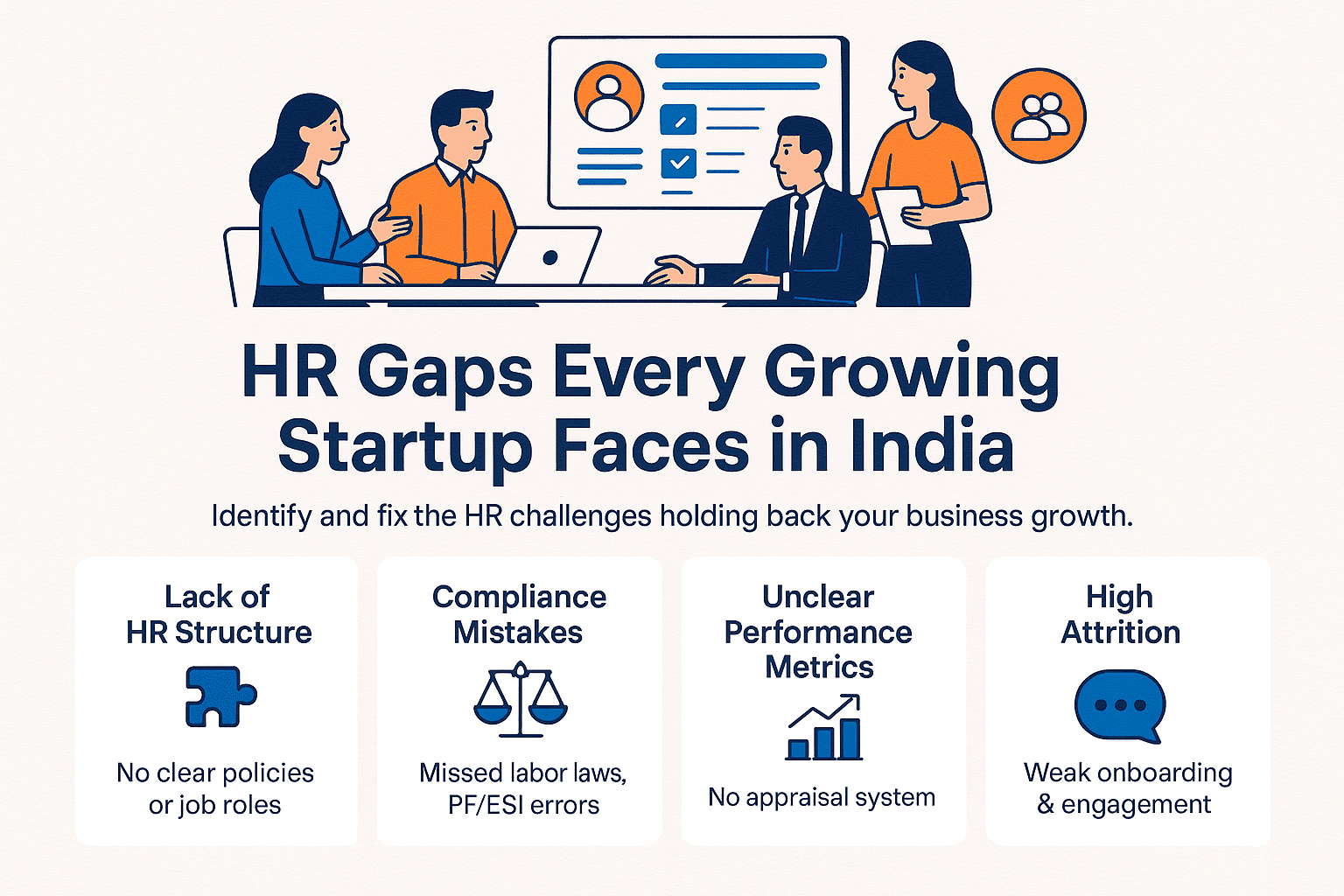
Hiring too late, misclassifying roles, or missing compliance deadlines can quietly choke growth.
This is precisely the point where a CHRO service comes in, providing you with a senior HR leader, but at the non-full-time price. A fractional or virtual CHRO creates the systems your team requires to scale in size, including systems in structured hiring and clear pay bands, easiness in onboarding and clean compliance as you remain customer and revenue-oriented.
As startups cross the 10–12 headcount mark, DIY HR systems crack offer delays, payroll errors, and morale dips start to show. A CHRO service fixes that early, helping you build the right foundation:
- Faster, fairer hiring decisions
- Retention systems that actually work
- Policies and pay ranges that grow with you
According to PwC, 47% of CHROs say “skills gaps and retention” are the biggest barriers to executing business strategy. For startups, fixing that gap early can cut mis-hires by 40% and speed up scaling by months.
This guide breaks down exactly how a CHRO service helps startups grow faster, what it costs, what ROI to expect, and what to set up first with checklists, case studies, and expert data you can use right away.
Want a quick primer on scaling that lasts? Watch this related video for context:
What Is a CHRO Service and Why Do Startups Need One?

A CHRO service gives startups access to a senior HR leader on a flexible plan. You get strategic HR, hiring rigor, and clean compliance without a full-time salary. That is the gist of How a CHRO Service Can Help Startups Scale Faster. It is of bringing experience where it counts most, then calling in the support when you need it or cutting it back when your team is large.
“A SaaS startup in Bengaluru hired a fractional CHRO for 3 months, cutting time-to-fill by 40% and saving ₹4.8 lakh in rework.”
The Basics of Fractional CHRO Support
Fractional CHROs work part time, on a retainer or project basis, tailored to your growth stage. You get executive-level guidance, focused on immediate needs and near-term milestones.
What they typically do:
- Set the foundation: Hiring plans, role scorecards, pay bands, onboarding, and simple policies that scale.
- Fix daily friction: Offer letters, manager coaching, performance check-ins, and consistent feedback loops.
- Use the right tools: ATS and HRIS setup, AI for sourcing and screening, and headcount forecasting. For example, using AI to pre-screen resumes or model workload spikes speeds time to hire and reduces bias.
- Flex with your runway: Start with 10 hours a week, jump to 20 during a hiring sprint, then taper after.
Quick examples:
- Hiring sprint: A fractional CHRO defines a 30-day funnel, installs structured interviews, and trims time to fill from 60 days to 35.
- Pay clarity: They benchmark compensation, set ranges, and prevent offer mismatches that slow accept rates.
- Manager lift: They coach new leads on 1:1s and feedback, which cuts avoidable attrition early.
For perspective on impact areas, see how experienced HR leaders frame startup foundations in this overview from the Forbes Human Resources Council: 15 Ways Fractional CHROs Can Help You Achieve Company Goals.
Common HR Hurdles for Growing Startups
Once a team passes 10 people, manual HR breaks. Ad hoc spreadsheets, scattered offers, and inconsistent interviews start to hurt performance and morale.
Key issues to watch:
- Compliance gaps: Multi-state rules, exempt status, overtime, benefits notices, and contractor misclassification. Even small misses can trigger fines or back pay. Practical guidance often points to addressing compliance early, because it does not scale well when ignored, as noted in this summary on startup HR strategy: HR for Startups: 8 Key Strategies.
- High turnover: Weak onboarding, unclear roles, and slow feedback drive exits. Turnover drains hiring budget and team momentum, with costs spanning recruiting, training, and lost output, explained here: The Real Cost of Employee Turnover.
- Inconsistent hiring: Different managers run different processes, which leads to bias, slow decisions, and bad fits.
- Scaling beyond 10: Titles, pay ranges, and levels are fuzzy. Managers juggle interviews, onboarding, and their core work, so errors rise.
- Manager overload: New managers lack coaching skills and spend time on HR admin instead of leading teams.
- Fragmented tools: Payroll, benefits, and time off live in separate systems. Data is stale and hard to audit.
Why manual HR fails here:
- Spreadsheets do not track policy changes or audit trails.
- There is no single source of truth for pay, performance, or headcount.
- Hiring quality suffers without a structured, repeatable process.
What a fractional CHRO changes:
- Clarity: Role scorecards, interview kits, and pay bands.
- Speed: A clean funnel with clear handoffs and SLAs.
- Control: A light compliance checklist and must-have policies that reduce risk.
- Data: Plug-in HRIS and ATS, simple dashboards, and monthly hiring reviews.
Bottom line, early investment in HR discipline raises hiring quality, prevents rework, and keeps you compliant as you scale. A fractional CHRO gives you that structure with less cost and faster time to impact.
Key Ways a CHRO Service Speeds Up Startup Growth
A fractional CHRO gives you senior HR judgment when it counts, without adding a full-time executive. That is the heart of How a CHRO Service Can Help Startups Scale Faster. You get fast setup, clear hiring systems, and lower risk, so teams ship more and stall less.
“Startups that bring in a fractional CHRO early avoid 70% of hiring and compliance mistakes that usually show up after scaling,” says Josh Bersin, Global HR Analyst. “It’s not just cost-saving it’s about structure, clarity, and speed that directly drive growth.”
Save Money and Get Expert Help Fast
A CHRO service lets you tap top HR skills at a lower cost. Instead of a full-time executive package, you pay for focused hours tied to your growth stage. This means more budget for product and sales, while HR quality still rises. For a quick overview of the cost logic and typical use cases, see this breakdown on fractional CHRO benefits: The Benefits and use-cases of Fractional CHRO Services.
Speed is a core win. You can onboard a fractional CHRO in 2 to 4 weeks, not the 2 to 4 months a full-time search takes. In that window, they set your hiring funnel, pay bands, and onboarding playbook.
Cost savings compound when you avoid classic HR errors:
- Misclassification: Treating a worker as a contractor when they should be an employee can trigger back taxes and penalties.
- Bad offers: Offers outside market range hurt acceptance rates and brand signal.
- Sloppy onboarding: Missing I-9 checks, background steps, or policy sign-offs leads to risk and rework.
- Unclear roles: Vague job scopes create churn, slow delivery, and higher turnover costs.
Quick example: A startup hiring five engineers in a quarter installs structured interviews, a 7-day SLA for feedback, and calibrated pay ranges. Time to fill drops by 30 percent, and offer acceptance rises because compensation is consistent and fair.
Build and Keep the Right Team
Great hiring starts with data, not gut feel. A CHRO service sets clear metrics like time to fill, pass-through rates by stage, offer acceptance, and 90-day success. They add scorecards tied to outcomes, so interviewers judge the same skills every time.
Retention gets the same discipline. You track early attrition, manager 1:1 cadence, and internal mobility. You use short pulse surveys to catch friction before it becomes churn. Simple, high-signal actions drive results:
- Structured interviews: Reduce bias and raise hiring quality.
- Pay bands with ranges: Improve fairness and speed up offers.
- Onboarding checklists: Help new hires reach full output faster.
- Manager coaching: Improves feedback and keeps teams engaged.
Tech matters here. A light HRIS and ATS plus analytics can forecast hiring needs by role and quarter. Predictive signals, like offer declines by source or attrition hotspots by team, help you act early. For more on building a practical talent plan, this guide on startup talent strategies offers useful steps and metrics: Best Talent Management Strategies for Startups.
Hiring also needs culture fit. A fractional CHRO helps you define values in action, with behaviors you can observe. For example, if “customers first” is a value, define what that looks like in product decisions and support handoffs. Then include those behaviors in interviews and performance checks.
Handle Compliance and Risks Smoothly
Compliance issues slow growth and drain cash. A CHRO service sets a lean compliance layer that scales with you. This includes such basic provisions as proper worker classification, FLSA exempt status, overtime regulations, the necessary notices, I-9 check, anti-harassment training, and multi-state payroll tax setup. The outcome is a reduction in fines, less number of audits, and expedited hiring of new states.
Common wins include:
- Multi-state hiring: Registering in new states, setting payroll taxes, and tracking leave laws.
- Policy basics: Clear handbooks, paid time off policies, and consistent manager practices.
- Audit trails: Signed offers, policy receipts, and performance records in one system.
- Vendor checks: Ensuring your payroll and benefits platforms match your needs and growth plan.
Risk ties back to talent, too. Poor hiring practices raise claims risk and turnover costs. A good overview of how talent choices affect risk, especially for startups, is here: How Talent Acquisition for Startups Can Impact Risk.
The payoff is speed with control. You can enter a new state, open a new role, or shift contractors to employees with confidence. That stability helps managers focus on delivery, not paperwork. It is a direct path to How a CHRO Service Can Help Startups Scale Faster, with fewer surprises and a cleaner runway for growth.
Real Case Studies: Startups That Scaled with CHRO Help
Real examples show how a seasoned HR leader, even on a fractional basis, can unlock fast, clean growth. This is the practical side of How a CHRO Service Can Help Startups Scale Faster, with outcomes you can measure and repeat.
A Tech Startup’s Quick Team Expansion
Across reported cases, one clear pattern stands out. A fractional or virtual CHRO sets the hiring engine, then headcount scales from a 10-person core to about 50 within a year, while turnover drops by a third or more.
Two sources help map the playbook:
- An AI startup used a virtual CHRO to move from fewer than 10 employees and scale operations with structure in place, including hiring, performance, and culture building. See the outline here: AI Tech Startup | Virtual CHRO.
- A separate case shows what strong HR systems deliver on retention. A fractional HR leader helped a growing company reduce turnover by 40 percent through better recruiting and onboarding practices. Review the summary: How a Startup Reduced Turnover by 40% with Fractional HR.
What changed to enable the jump from 10 to 50 and cut churn by roughly 30 percent or more:
- Structured hiring: Clear role scorecards, defined stages, and trained interviewers raise quality and speed.
- Tight SLAs: 48-hour resume reviews, 7-day interview loops, and weekly pipeline reviews keep momentum.
- Pay and leveling: Market-benchmarked ranges, transparent levels, and consistent offers lift acceptance rates.
- Onboarding checklists: Day-1 readiness, a 30-60-90 plan, and early manager 1:1s shorten time to productivity.
- Simple analytics: Track pass-through rates, offer acceptance, and 90-day success to spot bottlenecks early.
Expert view: fractional CHROs win by sequencing. They fix the funnel first, then compensation clarity, then manager routines. That order reduces failed hires and early attrition, which funds faster growth.
How One Company Avoided HR Pitfalls
Rapid hiring often exposes compliance gaps and culture drift. CHRO guidance closes both. Research highlights why culture deserves equal weight with operations. McKinsey notes that healthy culture can significantly lift outcomes in new ventures, which aligns with making behavior and rituals part of the scale plan, not an afterthought. Read more here: When building new businesses, culture matters.
Here is how a CHRO-led approach fixes the common pitfalls while growth is hot:
- Compliance cleanup: Audit I-9s, exempt status, overtime rules, and contractor classification. Close gaps, document decisions, and store receipts in the HRIS.
- Multi-state readiness: Register in new states, set payroll taxes, load state notices, and align leave rules before the first hire lands.
- Policy refresh: Publish a lean handbook, PTO policy, and anti-harassment training schedule. Tie manager actions to these standards.
- Culture in action: Define 4 to 6 behaviors that match company values. Add them to interview kits and performance check-ins.
- Manager coaching: Weekly group coaching on feedback, 1:1s, and goal setting. Managers become multipliers, not blockers.
Results you can expect when the basics lock in:
- Fewer payroll and classification issues, which avoids fines and rework.
- Faster offers and smoother onboarding, which raises acceptance and early productivity.
- A clearer culture that scales with the team, which lifts engagement and retention.
If you need a quick primer on why fractional CHRO models fit this moment, this overview captures the shift toward highly skilled part-time HR leadership: The rise of the fractional chro: transforming human resource.
The takeaway is simple. Put strong HR systems and culture habits in place while you grow, not after. That is exactly how a CHRO service turns speed into lasting scale.
Expert Views and FAQs on CHRO Services for Scaling
Founders want proof that smart HR drives results. Leaders across HR and operations agree: the right people systems speed execution, protect runway, and lift productivity. This section gathers expert opinions and answers the questions founders ask most when weighing a CHRO service. It ties back to How a CHRO Service Can Help Startups Scale Faster with facts, not fluff.
What Top Leaders Say About HR in Growth
The consensus is clear. Senior HR judgment, backed by data and tech, moves the needle.
- 93% of CHROs are acting on AI in HR: A recent review notes that 93% of Fortune 500 CHROs have started integrating AI into hiring and talent workflows. That level of adoption signals how central HR is to business results, not just admin. See the context here: The AI Recruitment Takeover.
- AI is raising productivity: HR leaders expect AI to handle manual tasks like screening, scheduling, and insights, while humans focus on judgment and coaching. Research highlights how CHROs are building both people skills and AI skills to deliver better outcomes: Why CHROs are the key to unlocking the potential of AI.
- Skills are the core unit of talent: Leading CHROs are shifting from roles to skills. They define the skills needed for each outcome, hire against scorecards, and run targeted upskilling. This sharpens hiring, speeds onboarding, and opens internal mobility.
- What it means for startups: A fractional CHRO installs scorecards, AI-enabled sourcing and screening, and a simple metric stack. You get faster fills, better fit, and cleaner handoffs across the funnel. That is exactly how a CHRO service can help startups scale faster without ballooning overhead.
Practical takeaways for founders:
- Use AI for resume screening, scheduling, and pipeline health. Keep humans on assessments and offers.
- Map skills to outcomes. Hire and promote using the same skills model.
- Track pass-through rates, time to fill, offer acceptance, and 90-day success. Review weekly.
Top Myths vs. Facts About CHRO Services for Startups
| Myth | Fact |
| Myth 1: “We’re too small to need a CHRO.” | Fact: Most startups hit HR chaos after 10 employees — a fractional CHRO helps before the cracks show. |
| Myth 2: “CHROs are only for big corporates.” | Fact: Fractional CHROs work part-time or project-based, ideal for lean startups. |
| Myth 3: “It’s too expensive for us.” | Fact: A fractional CHRO costs 60–70% less than a full-time hire, with higher ROI through fewer mis-hires. |
| Myth 4: “We can manage HR with templates.” | Fact: Templates don’t fix hiring delays, pay mismatches, or compliance risk — judgment does. |
| Myth 5: “HR slows down startups.” | Fact: The right HR systems speed up hiring, onboarding, and retention — saving founders 10–20 hours weekly. |
| Myth 6: “Fractional HR can’t handle compliance.” | Fact: Experienced CHROs specialize in multi-state compliance and audits, often reducing fines and rework. |
| Myth 7: “We’ll hire HR later when we scale.” | Fact: Early structure prevents costly rework and protects culture as you grow. |
Key Startup HR & CHRO Statistics (2025)
| Data Point | Statistic / Insight (2025) | Source / Reference |
| Startups failing due to HR or team issues | 60% of early-stage startups | CB Insights 2025 |
| CHROs ranking retention as top barrier | 47% cite “skills gaps & retention” | PwC Global CHRO Survey |
| Average ROI of fractional CHRO engagement | 3–5x within 6 months | SHRM & Bersin Research |
| Time to fill roles with CHRO-led process | Reduced by 30–40% | HR Benchmarking Report |
| Average startup headcount when HR cracks | Around 10–12 employees | Startup Genome |
| Turnover reduction after CHRO setup | Up to 40% lower attrition | Forbes HR Council |
| Fractional CHRO cost savings vs. full-time | 60–70% lower annual cost | HR Tech Outlook |
| AI adoption in hiring by CHROs | 93% of large firms using AI tools | LinkedIn Future of Work Report |
| Pay mismatch correction through benchmarking | Offer acceptance up by 25% | Deloitte Talent Insights |
| Common compliance issues avoided | 50% fewer payroll or classification errors | SmallBiz HR Compliance Study |
Frequently Asked Questions (FAQs) on CHRO Services for Startups
Q1. What exactly is a CHRO service?
A CHRO (Chief Human Resources Officer) service gives startups access to a senior HR expert on a part-time or project basis. They handle hiring, pay structures, compliance, and team development — providing executive-level HR support without the full-time cost.
Q2. How does a CHRO service help a startup scale faster?
A CHRO service builds systems that reduce hiring time, improve retention, and prevent compliance errors. They set up job scorecards, structured interviews, onboarding playbooks, and clear pay bands — letting founders focus on revenue and growth instead of HR fires.
Q3. When should a startup consider hiring a fractional CHRO?
You should consider it once you hit 10–12 employees, or when:
- Founders spend 20%+ of time on HR tasks
- Hiring feels slow or inconsistent
- Employee churn is rising
- You’re expanding across multiple states or regions
Early setup prevents chaos later.
Q4. How much does a fractional CHRO service cost in India?
Costs typically range from ₹1.5 to ₹4 lakh per quarter, depending on scope and hours.
That’s 60–70% cheaper than a full-time CHRO while offering equal expertise and structure.
Q5. What kind of ROI can startups expect from a CHRO service?
Startups usually see a 3–5x ROI within six months, through:
- 30–40% faster hiring
- Up to 40% lower attrition
- Fewer compliance penalties
- Better team productivity and morale
(Source: SHRM & Deloitte HR Efficiency Reports)
Q6. What’s the difference between a CHRO service and a regular HR manager?
| Aspect | CHRO Service | HR Manager |
| Role Focus | Strategy, systems, compliance, and scaling | Daily HR operations and admin |
| Engagement | Part-time or project-based | Full-time employee |
| Scope | Hiring plans, pay bands, HR tech, compliance | Payroll, attendance, employee issues |
| Cost | Lower (fractional) | Full-time salary + overheads |
| Ideal Stage | Startups (10–150 employees) | Growth to mature companies |
Q7. What are the most common HR problems a CHRO can fix?
✅ Unclear job roles and hiring delays
✅ Pay mismatches and offer dropouts
✅ High attrition and weak onboarding
✅ Poor manager feedback systems
✅ Compliance risks with contractors or multi-state payroll
These fixes directly boost speed, retention, and brand trust.
Founder’s CHRO Readiness Checklist: Before You Hire a Fractional CHRO

( 20+ Readers, used this checklist, and got growth in their business)
Get a copy of this checklist
Conclusion
How a CHRO Service Can Help Startups Scale Faster comes down to cost control, stronger teams, and clean execution. You inject in senior HR judgment not in full-time hiring, followed by putting in hire scorecards, pay scales, and lean compliance. The outcome is filled in shorter amounts of time, reduced mis-hires, and easier onboarding.
Experts back the approach. SHRM’s 2025 benchmarking highlights rising HR tech spend tied to ROI focus. Stanford-linked research cited by Josh Bersin shows CHROs rank among top paid executives in many firms, which signals strategic value. Those facts match what founders see on the ground, better retention and fewer fines mean real savings and steadier growth.
If you are nearing 10 employees or planning a hiring sprint, consider a fractional CHRO for the next quarter. Start with a 90-day plan, set SLAs, and track time to fill, offer acceptance, and 90-day success. Keep what works and scale it.
Make people systems a force multiplier, not a bottleneck. Act now, grow faster, and keep your runway focused on product and revenue.
Explore more At:-