Table of Contents
Summary
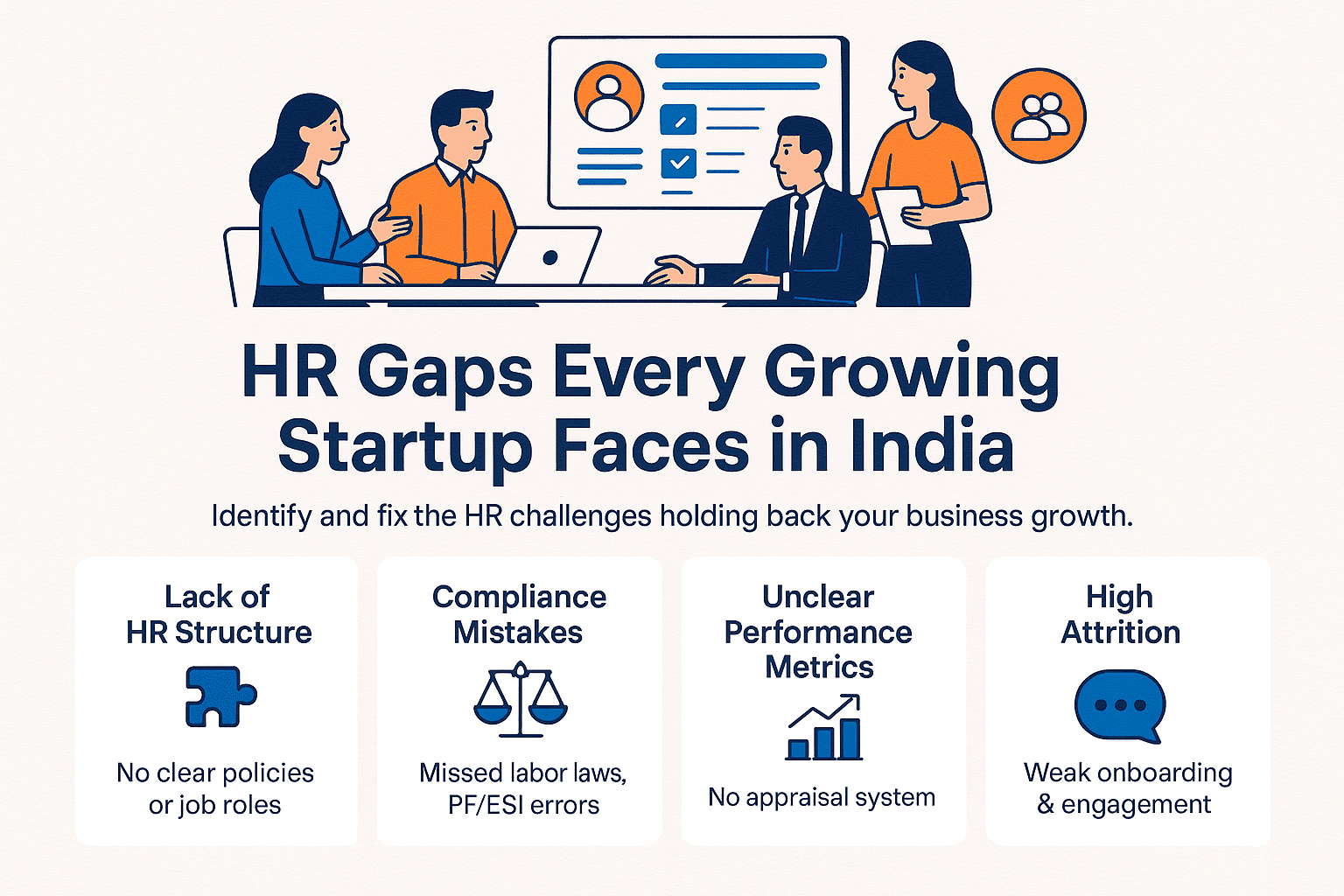
Running a small business comes with countless responsibilities, and HR often gets overlooked—leading to costly mistakes. Nearly 70% of small businesses face HR compliance issues yearly, with average fines reaching ₹8-10 lakh ($10,000) due to payroll errors, employee misclassification, and outdated policies. A simple HR audit can help prevent these issues before they turn into fines, legal trouble, or damaged reputation.
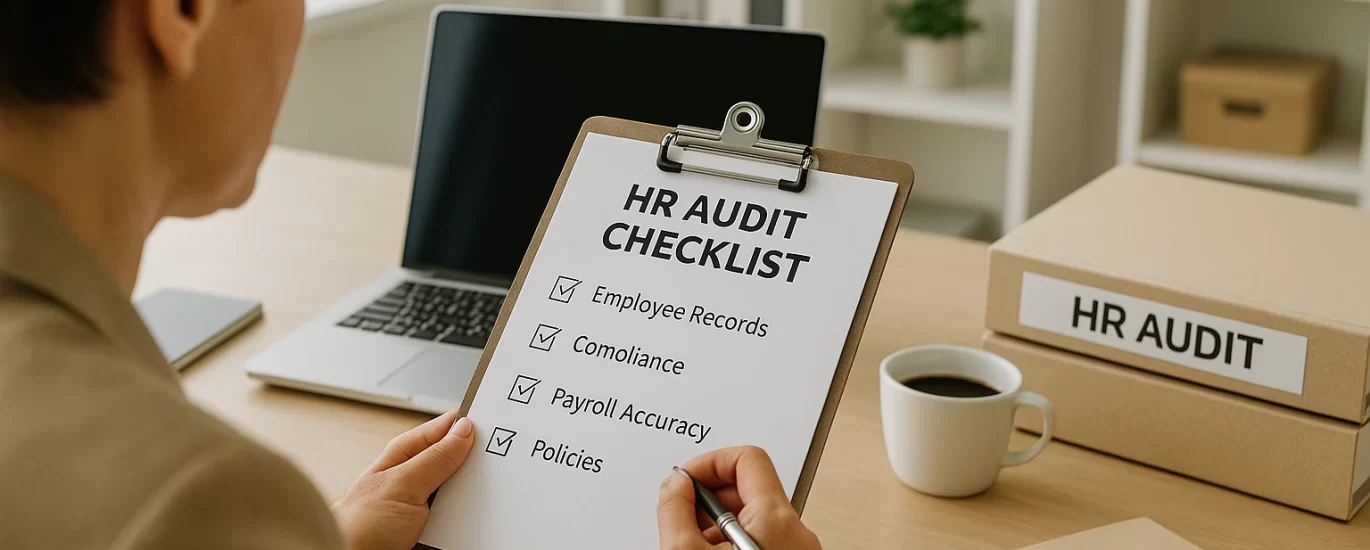
This Free HR Audit Checklist is designed to guide small business owners through a comprehensive review of their HR systems. Key areas to focus on include:
- Hiring and Onboarding: Ensure all documentation is complete and accurate (I-9s, W-4s, job descriptions).
- Payroll and Taxes: Double-check pay classifications, overtime, and tax filings.
- Benefits and Leave: Verify eligibility and policy compliance with state regulations.
- Data Privacy and Policies: Secure personnel records and maintain up-to-date employee handbooks.
The checklist also provides a 30-day audit plan, from setting scope in Week 1 to addressing critical issues in Week 4. You’ll learn how to identify gaps, update policies, and track compliance quarterly—keeping your business audit-ready year-round.
Free tools like JustHr offer step-by-step templates, risk scoring, and actionable reports to simplify this process, all at no cost. By performing regular audits, small businesses can reduce errors, build employee trust, and save on costly penalties, ensuring smoother operations and legal protection.
Introduction
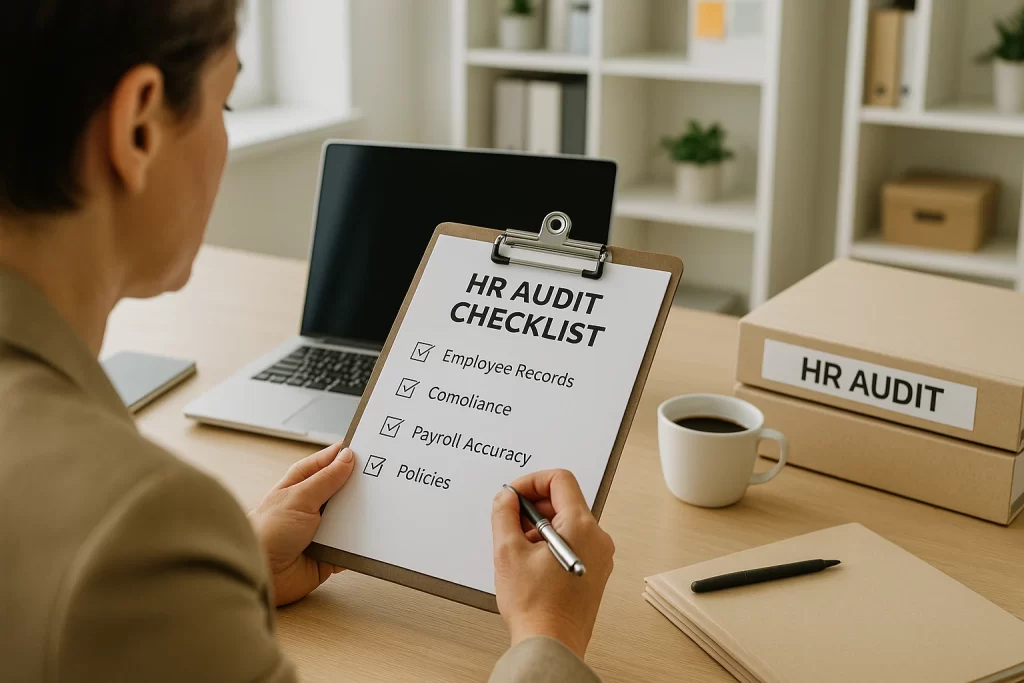
Did you know that nearly 70% of small businesses in India and the U.S. face compliance issues every year often without realizing it until fines or lawsuits arrive?
According to a 2025 HR Compliance Survey by Paychex, small firms lose an average of ₹8–10 lakh (≈approximately $10,000) annually due to payroll mistakes, employee misclassification, and outdated HR policies.
Running a small business means wearing many hats, from sales to payroll to hiring and HR, which often takes a backseat until something breaks. However, minor mistakes during the onboarding process, documentation, or remuneration regulations may result in fines, legal headaches, and staff turnover.
That’s where a Free HR Audit Checklist helps.
It gives you a clear, structured way to:
- Identify gaps before they turn into fines.
- Keep your employee records compliant.
- Protect your reputation and improve team trust.
In this guide, you’ll learn: - ✅ What to review in your HR systems
- ✅ How to fix the biggest compliance gaps
- ✅ How to run a 30-day HR audit plan
- ✅ Where to get free templates and tools (like JustHr) to simplify the process
Why an HR audit matters right now
Compliance mistakes drain money and time. Recent data shows small businesses lose an average of $10,000 per year due to HR non-compliance. The largest offenders are classification of employees, overtime mistakes, and payroll mistakes. There are lawsuits which cost tens of thousands in legal expenses due to some of the violations, and in extreme cases, penalties can be much greater. It is followed by reputation damage, which is harmful to hiring and sales.
Regulations keep changing in 2025. Rules on pay transparency, overtime entitlement and paid leaves are changing place in a number of states. Payroll limits, tax thresholds and benefit caps also change every year. A brief audit in every quarter will assist you to keep up to date and prevent fines.
“Most small businesses don’t fail compliance checks due to ignorance — they fail due to inconsistency,” says Anita Raghavan, HR Compliance Lead at SHRM India.
“Quarterly audits prevent cumulative errors that can become costly lawsuits later.”
According to Vantage Circle’s 2025 HR Compliance Outlook, regular HR audits improve employee satisfaction by 22%, as they build internal trust and transparency.
If you want a quick primer from a large provider, review ADP’s guide on core HR tasks. Their checklist breaks down recordkeeping, onboarding, and file completeness, which are common audit points for small teams. See the resource here: Know the HR Role: An Essential Checklist.
The small business HR audit checklist
Use this list to review the essentials. Mark each item pass, needs update, or missing.
- Hiring and onboarding
- Offer letters, I-9s, W-4s, state forms
- Background checks with signed consent
- Clear, current job descriptions with exempt or nonexempt status
- Pay and time
- Correct classification for exempt and nonexempt roles
- Overtime pay, meal and rest rules, timekeeping accuracy
- Final pay and state-specific timing rules
- Payroll and taxes
- Accurate deductions, garnishments, and payroll tax filings
- Records kept for the required period
- Benefits and leave
- Eligibility rules, plan documents, notices, and enrollments
- Paid sick leave, family leave, and PTO policies that match state law
- Safety and risk
- OSHA posters and logs if required
- Incident reporting and return-to-work steps
- Policies and training
- Anti-harassment, EEO, and code of conduct
- Handbooks signed and updated yearly
- Manager training on hiring, pay, and conduct
- Data privacy
- Secure storage of personnel files and medical records
- Limited access to sensitive data, clear data retention rules
- Culture and engagement
- Simple feedback loop, exit interviews, and fair complaint process
For a printable reference, this practical PDF is useful for a broad sweep across HR systems: Basic Human Resource (HR) Audit Checklist.
Legal Reference Section
| Regulation | Applies To | Why It Matters |
| Shops and Establishments Act | All businesses with employees | Sets rules for working hours, holidays, and pay |
| EPF & ESI Act | Companies with 10+ employees | Covers benefits and social security |
| FLSA (U.S.) | U.S.-based or hybrid operations | Defines overtime and classification |
| POSH Act, 2013 | All workplaces in India | Mandatory sexual harassment prevention policy |
Quick document map for your audit
| Area | Key documents to verify | Where to look |
| Hiring | I-9s, W-4s, offer letters, job descriptions | Personnel files, HR drive |
| Classification | Exempt or nonexempt designations, pay bands | Role library, compensation sheet |
| Time and pay | Timesheets, overtime reports, payroll registers | Time system, payroll exports |
| Benefits | Plan docs, enrollments, COBRA or state notices | Benefits portal, HR files |
| Leave | PTO policy, sick leave logs, leave requests | Handbook, manager records |
| Safety | OSHA logs, training records, incident reports | Safety binder, shared drive |
| Policies | Handbook, signed acknowledgments, training logs | HRIS, shared drive |
| Data privacy | Access logs, encryption settings, retention map | IT policies, HR system |
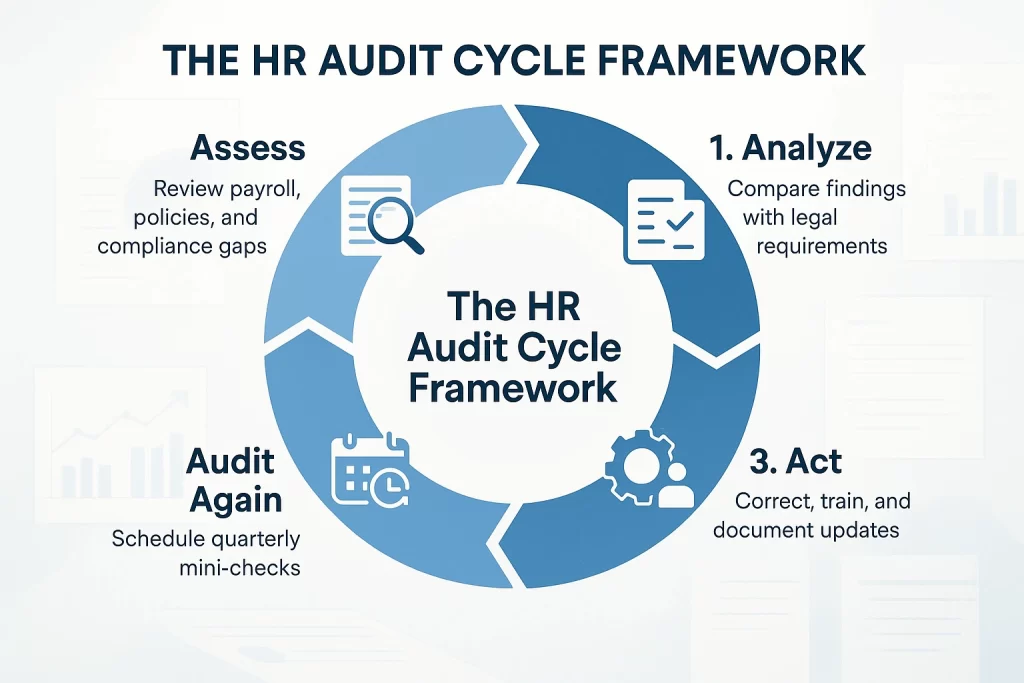
Step by step: run the audit in 30 days
- Week 1, set the scope
- Pick your focus: compliance, payroll accuracy, or hiring hygiene.
- List the documents you will check and who holds them.
- Freeze changes during the audit to keep your baseline clean.
- Week 2, collect and sample
- Pull 10 to 20 percent of personnel files, or at least 10.
- Sample two payroll periods for pay and time accuracy.
- Review one full year of leave records for patterns or gaps.
- Week 3, compare and flag
- Compare policies to state and federal rules.
- Flag missing forms and outdated policies.
- Note any misclassification risks and overtime errors.
- Week 4, fix high-risk items first
- Correct I-9s, pay rates, overtime rules, and misclassification.
- Update the handbook and get fresh acknowledgments.
- Train managers on any policy changes.
Tip: If you are building HR from scratch at a startup pace, this guide can help you set the basics with simple steps: HR Checklist for Startups and Small Businesses.
Common gaps and fast fixes
- Misclassified roles
- Risk: Back pay, penalties, benefits owed.
- Fix: Re-check duties tests for exempt roles. Adjust titles and pay where needed.
- Incomplete files
- Risk: Fines for missing I-9s, poor defense in disputes.
- Fix: Create a file index. Track I-9s separately. Use a new hire packet checklist.
- Overtime errors
- Risk: FLSA claims and class actions.
- Fix: Audit timekeeping rules, round only as allowed, pay all hours worked.
- Outdated handbook
- Risk: Uneven treatment and legal exposure.
- Fix: Update policies yearly and obtain fresh signatures.
- Weak data controls
- Risk: Privacy complaints and security incidents.
- Fix: Limit access, encrypt data, set retention timelines, and train staff.
For a broader view of compliance duties that hit small businesses most, this guide is a solid read: HR Compliance For Small Businesses.
Common Myths vs. Facts About HR Audits
| Myth | Fact |
| “HR audits are only for big companies.” | Even small businesses with 5–10 employees face the same compliance laws. Audits are essential at every stage. |
| “It’s too expensive to run an HR audit.” | Many platforms (like JustHr) provide free audit templates that cost nothing to implement. |
| “Once I fix things, I don’t need to audit again.” | Regulations change frequently. A quarterly mini-audit helps you stay up to date. |
| “If I have payroll software, I’m fully compliant.” | Payroll tools handle calculations, not classification, documentation, or training compliance. |
| “My accountant manages HR compliance.” | Accountants handle taxes, but HR compliance involves employee relations, policies, and labor laws. |
Key HR Compliance Statistics for Small Businesses (2024–2025)
| Source / Report | Key Finding | Impact on Small Businesses |
| Paychex Compliance Survey (2025) | 68% of small businesses made at least one HR compliance error in the last 12 months. | Frequent fines and back pay issues due to lack of HR systems. |
| ADP Small Business Report (2024) | The average non-compliance fine for small firms is ₹8–10 lakh per year. | Payroll and tax filing mistakes are top risk areas. |
| SHRM India Workplace Study (2025) | 41% of SMEs have outdated employee handbooks and policies. | Creates inconsistency, legal exposure, and low employee confidence. |
| Statista HR Operations Study (2024) | 56% of small companies don’t track exempt vs. non-exempt classification correctly. | Leads to wage disputes and audit failures. |
| JustHR Internal Data (2025) | Companies running quarterly HR audits reduce compliance issues by 35%. | Preventive auditing saves time and money. |
💡 Insight:
Regular HR audits not only prevent legal issues but also improve transparency, retention, and employer branding — especially when your team grows fast.
Expert take: what matters most
Seasoned HR leaders focus on three priorities. First, pay and classification accuracy, since this affects nearly every employee and drives the highest claims. Second, clean documentation, because well-kept records protect both the company and employees. Third, manager training, since most issues start with inconsistent day-to-day actions. Employment attorneys often advise putting written policies in place, then training supervisors until they can apply those policies without guesswork.
Industry checklists from reputable providers echo these themes. For example, Factorial’s 2025 checklist outlines core compliance, documentation, and people operations in a simple format: 2025 HR Audit Checklist, Free Template.
“We thought HR audits were for large firms until one saved us ₹6 lakh in penalties.”
— Karan Mehta, Founder, BluePulse Tech (Noida)
“The JustHr checklist helped us clean up years of unorganized data in just a week.”
— Ritika Sharma, HR Lead, HealthNest India
Use JustHr to run a complete, free HR audit
If you want a ready-to-use workbook designed for small teams, use JustHr. It is built to help owners and office managers run a complete review with no cost.
What you get with JustHr:
- Clean, step-by-step checklist that matches the sections in this guide
- Ready templates for I-9 review, personnel file audits, and policy updates
- Risk scoring for each area, so you know what to fix first
- Manager training prompts and sample scripts
- Simple reports you can share with owners or investors
How to use it today:
- Download the free JustHr checklist.
- Pick your scope based on your top risks.
- Complete the 30-day plan above.
- Share the results, then set quarterly check-ins.
For many small businesses, a structured checklist is the difference between guessing and growing. JustHr gives you the structure and clarity you need without adding tools you do not have time to manage.
Keep your audit fresh all year
- Schedule quarterly mini-audits, 60 minutes each.
- Track law updates for your state. Pay transparency and leave rules often change.
- Re-check exempt roles when duties change.
- Archive documents on a clear retention schedule.
A consistent rhythm keeps costs down and issues small. It also builds trust with your team, since people see fair, steady practices.
Startup HR Compliance & Audit Checklist
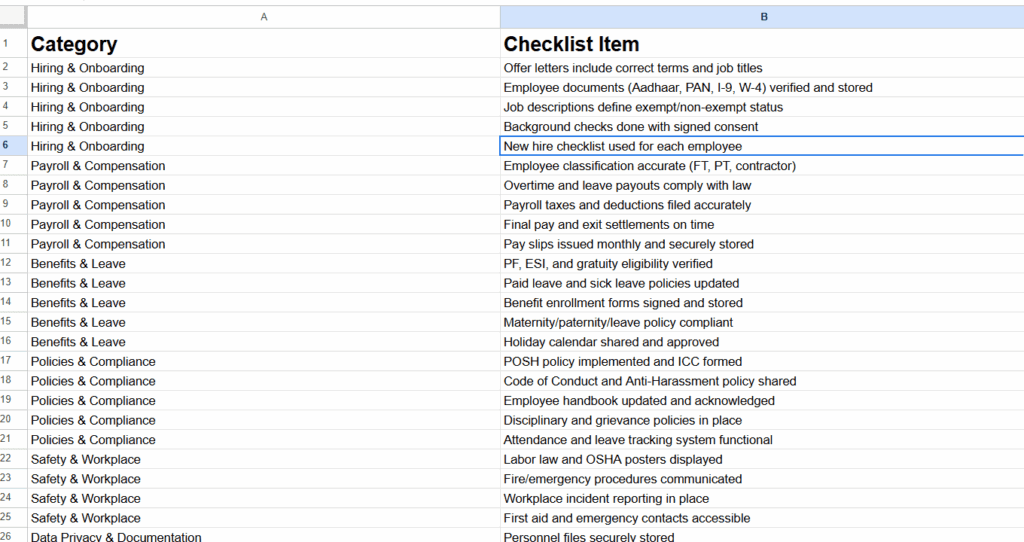
Get a copy of this checklist
FAQs: Free HR Audit Checklist for Small Businesses
1. What is an HR audit, and why do small businesses need one?
An HR audit is a structured review of your company’s people processes — from hiring and payroll to compliance and policies. Small businesses need it to avoid fines, improve employee trust, and ensure all legal and documentation requirements are up to date.
2. How often should I conduct an HR audit?
Ideally, you should run a mini HR audit every quarter (3 months) and a full audit once a year. Frequent reviews help you catch errors early, especially when employment laws or payroll rules change.
3. Is an HR audit expensive to run?
Not necessarily. Many free tools — like JustHr’s HR Audit Checklist — offer ready-to-use templates for small teams. You only need to invest time, not money, to stay compliant.
4. What are the most common HR compliance mistakes small businesses make?
The top five are:
- Misclassifying employees as contractors
- Missing I-9 or W-4 forms
- Incorrect overtime calculations
- Outdated employee handbooks
- Weak data privacy or record-keeping policies
5. What documents do I need for a basic HR audit?
Start with these essentials:
- Offer letters and employee contracts
- Payroll records and timesheets
- Tax filings and compliance certificates
- Leave and attendance logs
- Updated employee handbook
Conclusion
Most small businesses don’t fail because of bad intent they fail because of unnoticed HR gaps that grow over time. A missing form, a misclassified employee, or an outdated policy can quietly cost you lakhs in fines, lost trust, and sleepless nights. But the good news? You can prevent all of it with structure, not stress.
That’s exactly what the JustHr Free HR Audit Checklist is built for.
It’s not just a list it’s a smart, step-by-step system designed for Indian small businesses to stay compliant, organized, and audit-ready year-round.
With JustHr, you get:
✅ Clear guidance: Review every HR area from hiring to data privacy with simple, actionable checkpoints.
✅ Risk scoring: Instantly see which gaps need urgent fixes to avoid penalties.
✅ Ready templates: Pre-built files for I-9 checks, offer letters, payroll audits, and policy updates.
✅ Quarterly reminders: Keep your HR clean and compliant without outside consultants.
✅ Zero cost: 100% free for startups, SMEs, and growing teams.
India’s top small and mid-sized businesses now rely on JustHr to simplify compliance, protect employee trust, and save time. Whether you’re a 5-person startup or a 200-member firm scaling fast, JustHr gives you a compliance edge without expensive software or legal retainers.