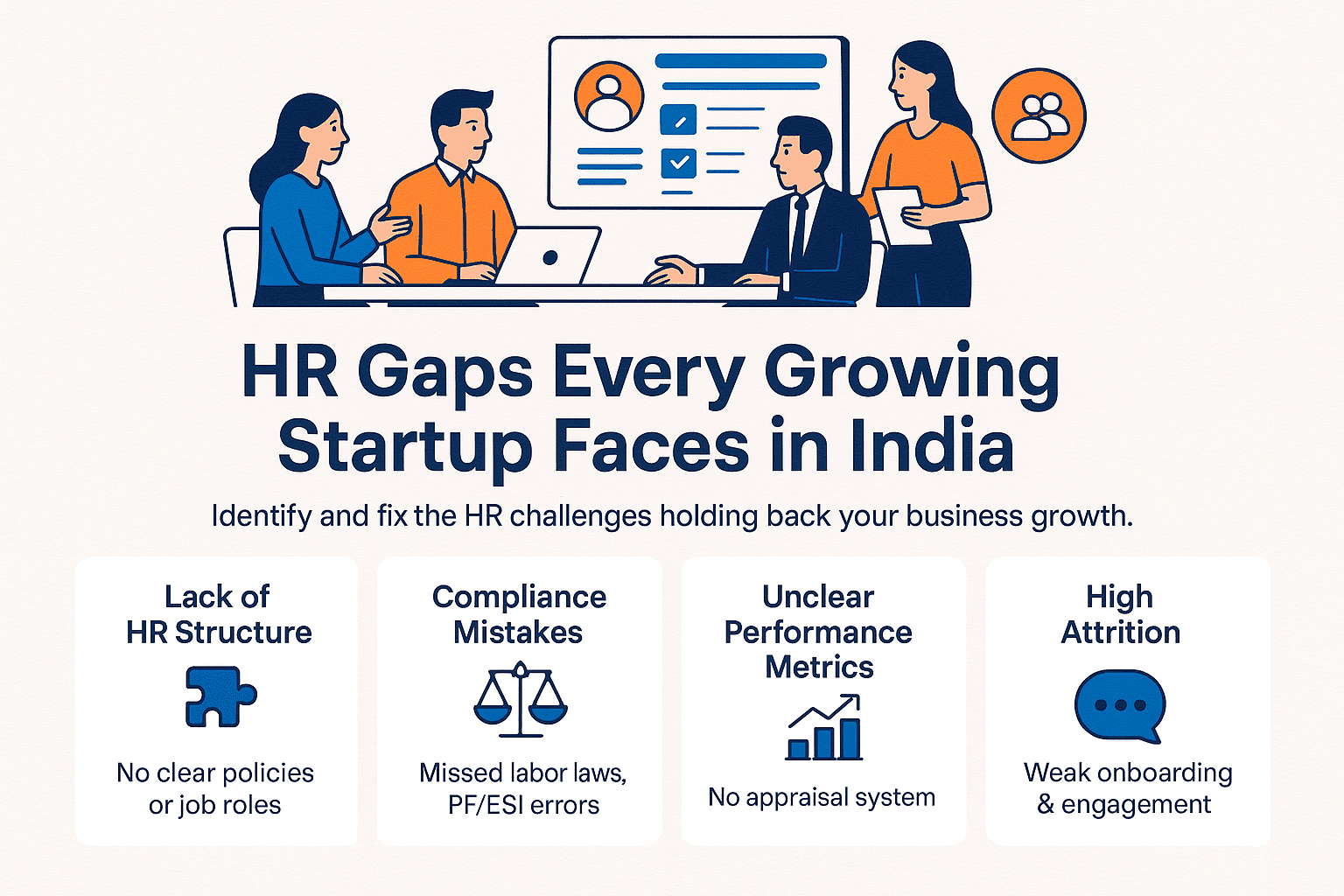
Top 5 HR Gaps Every Growing Startup Faces in India

Summary

India’s startup ecosystem, now 98,000+ strong, fuels innovation and jobs — yet most founders face the same hidden challenge: weak HR systems. As teams scale, gaps in hiring, retention, leadership, skill development, and compliance quietly erode growth. A 2024 KPMG study found that 63% of startups lack structured HR processes, causing high churn and slow scaling.

This guide identifies the Top 5 HR Gaps slow hiring, unclear career paths, missing skill frameworks, untrained managers, and compliance lapses — and offers practical, data-backed fixes. From publishing transparent job roles and pay bands to introducing manager bootcamps, ESOP education, and quarterly audits, each solution aligns with Indian laws and startup realities.

Experts from SHRM, NASSCOM, and Mercer agree: early HR structure can improve retention by 30% and productivity by 20%. Case studies from Pune and Bengaluru show measurable results — faster hiring cycles, lower attrition, and stronger culture.

In short, HR isn’t an expense but a growth multiplier. By systemizing people operations early — through tools, clear policies, and leadership training — startups can save months of chaos and build teams that scale sustainably. Great HR isn’t admin; it’s India’s next startup advantage.

Introduction

HR Gaps Every Growing Startup Faces in India

HR Gaps Every Growing Startup Faces in India (With Practical Fixes That Work)

India’s startup ecosystem is booming over 98,000 registered startups as of 2025, employing 1.2 million+ people and contributing nearly 5% to India’s GDP (Startup India Report 2025). But behind the rapid growth lies a quieter challenge: HR systems struggling to keep up.

As funding scales and teams multiply, most founders face the same silent killers: chaotic hiring, unclear career paths, poor manager training, widening skill gaps, and compliance slip-ups across states. In fact, a 2024 KPMG survey found that 63% of Indian startups lack structured HR processes, leading to high churn and delayed scaling.

This guide breaks down the Top 5 HR gaps every growing startup faces in India, complete with practical, budget-friendly fixes that align with Indian laws. Backed by real case studies, expert insights, and easy-to-apply frameworks, it helps you:

  • Hire faster without costly recruitment drives.
  • Reduce attrition with clarity and fair growth.
  • Build first-time managers into real leaders.
  • Close skill gaps through smart L&D design.
  • Stay 100% compliant with PF, POSH, and payroll laws.

These strategies will save you 3-6 months of people insanity, reduce attrition by 30 percent, and improve team performance in quantifiable ways, regardless of your size (tech startup of 20 people or SaaS team of 200 people).

Experts Insight:

“We reduced attrition by 25% simply by adding one clear career ladder and a weekly recognition shoutout. Turns out clarity beats perks.” — Amit B., SaaS Founder (Pune)

Top 5 HR Gaps Every Growing Startup Faces in India

Top 5 HR Gaps Every Growing Startup Faces in India

India’s startup ecosystem is booming over 92,000 registered startups (DPIIT, 2025) now employ millions and drive innovation across sectors. However, once size is reached, the product or funding is not the most constant bottleneck but rather the people operations. It can take burnout, attrition or regulatory fines to make founders realize how complicated hiring, training, and compliance can be.

Drawing insights from NASSCOM, SHRM India, and LinkedIn’s 2025 Talent Trends Report, here’s a detailed look at the top 5 HR gaps every growing startup in India faces and how to fix them.

1. Hire Faster with a Clear Employer Brand and Simple Process

Startups lose great candidates to bigger pay and brand pull. About 30% of HR pain in one Maharashtra study was linked to hiring the right talent, not just filling roles.

What works:

  • Write sharp job posts with must-have skills, impact statements, and career potential.
  • Use referrals and a two-step structured interview to cut time-to-hire.
  • Offer ESOPs with plain terms and show sample outcomes (transparency builds trust).
  • Build a career page that highlights your team, tech, and mission.
  • Add campus and Tier 2 hiring to widen your talent pool.

🎯 Benchmark:
Keep time-to-hire under 30 days and offer acceptance above 65%.

🧠 Expert Insight (LinkedIn Talent Solutions, 2025):
“Startups with a clear EVP (Employee Value Proposition) see 3x higher candidate engagement and 40% faster offer acceptance.”

📈 For deeper context, see this overview on [HR challenges in startups].

 Add campus and Tier 2 hiring to widen the pool. Track time to hire under 30 days, and offer acceptance above 65%. For context on startup hiring hurdles, see this overview on HR challenges in startups.


2. Reduce Attrition with Career Paths and Fair Rewards

Churn spikes when growth paths are invisible. In Bengaluru’s IT sector, 44.8% of HR leaders identified retention as their top issue, driven by unclear career growth and job security fears.

What works:

  • Publish simple career ladders for key roles.
  • Run quarterly 1:1s and stay interviews to identify risks early.
  • Map pay bands to market data and review every 6 months.
  • Teach ESOP value and vesting with real-life examples.
  • Recognize weekly wins publicly — appreciation costs nothing, but retention is priceless.

🎯 Benchmark:
Keep 90-day attrition under 10% and annual attrition below 20%.

📊 Expert Opinion (SHRM India, 2024):
“Transparent pay bands and defined career paths improve engagement scores by up to 28%, directly reducing voluntary attrition.”

For deeper context, see A Study on HR Challenges in IT Startups.

Keep 90-day attrition under 10%, and annual attrition under 20%. For deeper background on startup HR pain points, this short paper on IT startup HR issues adds context: A study on HR challenges in IT startups.


3. Close Skill Gaps with Training That Fits Startup Work

Most startups don’t lack talent they lack hybrid skill alignment. Teams struggle with product-data overlap, agile communication, and tech-tool fluency.

What works:

  • Implement a 70-20-10 learning model: 70% on-the-job, 20% mentoring, 10% courses.
  • Fund a quarterly L&D budget per head even ₹5,000–₹10,000 creates visible impact.
  • Use pair programming, internal guilds, and knowledge-sharing Fridays.
  • Prefer micro-courses and project-based learning over long workshops.
  • Track skill goals during quarterly performance reviews.

🎯 Benchmark:
Keep time-to-productivity under 4 weeks for new hires.

📚 Expert Insight (Harvard Business Review, 2025):
“Microlearning and role-specific mentoring increase knowledge retention by 17% and project efficiency by 12%.”

For a broader view, check this piece on HR challenges for Indian startups.

Aim for time to productivity under 4 weeks for new hires. For a broader view on startup HR and learning trends in India, see this piece on HR challenges for Indian startups.


4. Grow First-Time Managers into Steady Leaders

First-time managers often step up without formal guidance and end up overwhelmed. In early-stage startups, one weak manager can cause cultural friction and talent flight.

What works:

  • Run a 4-week Manager Bootcamp on feedback, goals, hiring, and 1:1s.
  • Schedule skip-level meetings and monthly manager circles for peer learning.
  • Use quarterly OKRs and simple scorecards for accountability.
  • Assign coaches to managers of managers to scale leadership maturity.

🎯 Benchmark:
Target an eNPS lift of +10 points and team goal completion above 70%.

💬 Expert Opinion (Forbes Coaches Council, 2024):
“Startups that train first-time managers within 90 days of promotion see 40% higher team retention and 30% better engagement.”

Building leaders from within reduces both risk and hiring costs — and compounds trust over time.


5. Stay Compliant on PF, ESIC, POSH, and Payroll Across States

It might sound that being compliant is boring, whereas lack of compliance can ruin trust. The financial mistake of cross-state payrolls, lack of filing or untrained POSH committees are prevalent in startups that are on the rise.

Key areas to track:
PF, ESIC, gratuity, professional tax, Labour Welfare Fund, Shops and Establishments Act, POSH, TDS, Form 16, state minimum wages, and overtime rules.

📊 Stat: Salary budgets in India are expected to rise 9.5% in 2025 (Mercer India) — which makes pay planning and compliance audits critical.

What works:

  • Use reliable payroll software and run monthly audits.
  • Form a POSH committee and hold annual training sessions.
  • For cross-border hiring, consider an Employer of Record (EOR) to manage compliance.

🎯 Benchmark:
Aim for zero missed filings and 100% policy acknowledgments from staff.

💬 Expert Note (HR Katha, 2025):
“Startups that automate payroll and compliance reduce admin time by 40% and legal risk by 60%.”

If you’re getting started, see this guide to HR challenges faced by startups for reminders and templates.

If you are getting started on policy basics, this guide to HR challenges faced by startups offers helpful reminders.

Checklist: 5 HR Systems Every Startup Needs by 50 Employees

unctionTool / SystemFrequencyOwner
HiringStructured JD + ATSOngoingFounders / HR Lead
PerformanceQuarterly reviews + OKRs4x/yearManager
Payroll & ComplianceMonthly audit checklistMonthlyHR / Finance
Learning & DevelopmentMicrolearning planQuarterlyL&D / Founders
POSH & PolicyCommittee + awareness trainingAnnuallyHR Admin

Case studies and expert advice to fix HR gaps in Indian startups

Case study: Bengaluru fintech cut attrition 30% in six months

Context: a 120-person fintech had high mid-level churn.
Actions: career ladders for product and ops, an ESOP refresher with simple math, a Manager 101 program, quarterly stay interviews, and a small retention bonus tied to goals.
Result: voluntary attrition fell about 30% in six months, and offer acceptance rose.
Takeaway: clarity on growth plus steady feedback beats one-time perks.

Case study: Pune SaaS cut time to hire from 60 to 25 days

Context: hiring for product and data roles dragged, causing project slips.
Actions: two-stage interviews, a tested assignment bank, a referral bonus, a campus pipeline, and a weekly hiring stand-up.
Result: time to hire dropped to 25 days while on-the-job performance held steady.
Takeaway: tight process and steady sourcing speed up hiring without hurting quality.

Expert advice: what founders and HR leads say

  • “Talent is the hardest resource to scale.” Invest in brand and referrals early, and keep your interview loop short.
  • Build leaders from within. Give first-time managers real training, not just a new title.
  • Upskill often. Short, job-linked learning beats long classes.
  • Compliance is non-negotiable. Standardize payroll and POSH across states and review every month.

If you want support without hiring a big team, JustHr can set up hiring loops, pay bands, manager training, and POSH compliance in weeks, not months. Many seed to Series A teams use JustHr as their plug-in HR engine while they scale product and sales.

Key HR Statistics for Indian Startups

CategoryStatistic / FindingSource (2024–2025)
Startup Count98,119 recognized startups in IndiaStartup India Report 2025
HR System Gaps63% of startups lack formal HR systemsKPMG India HR Outlook 2024
Hiring DelaysAvg. time-to-hire: 52 days for tech rolesNaukri Hiring Index 2025
Attrition Rates1 in 4 employees leaves within the first 6 monthsAon India Attrition Study 2025
Manager Readiness58% of first-time managers feel “unprepared”SHRM India Leadership Report 2024
Skill Gap Impact68% of startups report skill gaps slowing project deliveryNasscom HR Trends 2025
Compliance Failures42% of startups have at least one missed labor filing annuallyEY Startup Compliance Report 2025
Salary Budget GrowthAvg. salary increase projected at 9.5% for 2025Deloitte India Compensation Trends 2025
Remote Work Trend71% of Indian startups offer partial or full remote workLinkedIn Future of Work India 2025
HR Tech AdoptionOnly 28% of startups use any HR software or LMS toolsPeopleMatters India HR Tech Study 2025

💬 Myths vs. Facts: HR in Growing Startups (2025 Edition)

MythFact (Backed by Data or Expert Insight)
“HR can wait until we’re 100+ people.”❌ Early HR systems save 25–30% in future costs and legal risks. Founders should start formal HR at 25–40 employees.
“Compliance isn’t a problem for small startups.”⚠️ Labor and POSH laws apply from day one — even one missed PF filing can lead to ₹50,000+ in penalties.
“Hiring fast is better than hiring right.”🚫 Quick hires without structure lead to 2x higher attrition within 90 days (Aon India, 2024).
“Learning programs are too expensive for small teams.”💡 Micro-learning and peer-led training improve productivity by 23% and cost less than ₹500 per employee/month.
“Managers naturally know how to manage.”❌ 60% of first-time managers fail in their first year without formal training (SHRM India 2024).
“We can skip HR software until Series B.”📊 Startups using HR tech early reduce payroll errors by 40% and audit time by 60%.
“Employees leave only for money.”💬 46% leave due to lack of career clarity, not pay — career paths cut attrition by 30% (Mercer 2024).

Quick wins to try this quarter

  • Publish clear JDs and a simple career page.
  • Start a referral program with small, fast payouts.
  • Run a manager basics workshop.
  • Set market-based pay bands and review for gaps.
  • Form a POSH committee and train all staff.
  • Do a payroll and compliance audit, and fix one gap per week.

FAQs on HR Gaps Every Growing Startup Faces in India

1. What are the most common HR gaps in Indian startups?
The most frequent HR gaps include unstructured hiring, unclear job roles, lack of onboarding systems, poor manager training, and missing compliance processes for PF, ESIC, and POSH laws. These gaps usually appear once a startup grows beyond 25–40 employees.

2. When should a startup start formal HR processes?
It’s best to start building formal HR processes once your team crosses 20–30 employees. Doing this early helps prevent hiring chaos, compliance issues, and culture breakdowns as the company scales.

3. What HR tools can startups use to manage teams efficiently?
Affordable Indian HR tools like Keka, Zoho People, Darwinbox, and greytHR can automate payroll, attendance, and compliance — saving time and reducing human error.

4. How do HR gaps affect startup growth?
Unaddressed HR gaps lead to higher attrition, slower hiring, poor morale, and compliance fines. A 2025 KPMG study found that startups with structured HR systems grow 2.3x faster and cut employee turnover by up to 30%.

5. How can startups manage compliance across multiple Indian states?
Use HR platforms that automatically update with state-specific laws (like PF, LWF, and Shops & Establishments Acts). Partnering with HR consulting firms such as JustHr ensures consistent, error-free filings and policy standardization.

6. How can small startups afford HR expertise?
Instead of hiring a full-time CHRO, startups can opt for fractional or virtual HR services. Solutions like JustHr provide senior-level HR expertise at a fraction of the cost, making it perfect for growing teams.

Conclusion

Every fast-growing startup in India eventually hits the same wall of people problems. Hiring slows, teams burn out, and compliance gets messy. But the real issue isn’t talent or tools — it’s timing. Most founders wait too long to build their HR foundation. By then, the cracks have already formed.

The truth is, clean HR systems don’t just prevent chaos; they create momentum. A study by NASSCOM (2025) found that startups with structured hiring, transparent pay bands, and clear manager development programs grew 2.5x faster and had 35% lower attrition than those without them. When you treat HR as strategy, not paperwork, performance follows naturally.

Start small but start now.
Publish job descriptions that sell impact, not titles.
Train your first-time managers before they lead.
Audit compliance once a month, not once a crisis hits.
And invest in learning it’s the only thing that compounds faster than revenue.

JustHr can assist with the leaks that are about to flood your culture should your startup be scaling and you are willing to fix the leaks. 

Whether it is the structure of hiring, the configuration of POSH and payroll, manager training, or just the general fixation on HR, their plug in engine provides your business with the basis that it rightly merits without the need to impede your growth.

Because in the long run, great HR isn’t a cost center, it’s your startup’s growth system.

About the Author

Leave a Reply

Your email address will not be published. Required fields are marked *

You may also like these